
Commercial Janitorial Service Pricing Factors to Know

Table of Contents
Why Janitorial Pricing Varies So Much Between Providers
Commercial Cleaning Cost Per Square Foot: What Actually Drives It
Facility Size and Layout
Service Frequency and Daily vs. Weekly Schedules
Commercial Cleaning Scope of Work: The Line Items That Change Your Price
Floor Care, Deep Cleaning, and Specialty Tasks
Hidden Costs and Add-Ons to Watch For
Labor, Overhead, and Equipment: Where Your Money Goes
How a Burdened Labor Rate Is Built
Overhead: The Costs That Do Not Touch Your Floor
Equipment Tiers and the Payback Math
Where Green Cleaning and Specialty Equipment Fit
How to Compare Janitorial Service Quotes Without Getting Burned
Contract vs. Ad-Hoc Pricing: Which Model Fits Your Building
Why Recurring Contracts Cost Less Per Visit
Why Ad-Hoc Work Carries a Higher Rate
The Margin Structures Are Different
Minimum-Visit Economics
The Practical Combination
Budgeting Tips for Office Cleaning That Hold Up Over Time
Frequently Asked Questions
Last Updated: September 27, 2026
Why Janitorial Pricing Varies So Much Between Providers
Commercial janitorial service pricing factors vary because no two facilities generate the same workload. Square footage, traffic patterns, floor types, and service frequency all shift what a provider must charge, two identical-size buildings can differ by thousands a year.
Commercial Cleaning Cost Per Square Foot: What Actually Drives It
Commercial cleaning cost per square foot is the industry's default pricing model, but it is a starting point, not a final answer. A building with dense cubicles, multiple restrooms, and hard-surface flooring costs more per square foot than an open warehouse with sealed concrete.

Facility Size and Layout
Larger facilities benefit from economies of scale, but layout complexity erodes them fast. A 10,000-square-foot open office cleans faster per square foot than the same area split into forty private suites, each with its own trash, glass, and floor care.
Restroom count: the single biggest cost multiplier in most buildings
Flooring mix: carpet, tile, vinyl, and polished concrete each demand different labor and equipment
Density: cubicle farms slow down vacuuming and dusting compared to open plan
Access: badge-controlled areas, server rooms, and after-hours-only zones add labor time
Service Frequency and Daily vs. Weekly Schedules
Frequency drives labor hours more than any other variable. Five nights a week costs substantially more than twice-weekly service, but it prevents the buildup that turns routine maintenance into deep cleaning. Cutting frequency often means paying for a deep clean that costs more than the nights you removed. Match frequency to actual occupancy, not habit.
Commercial Cleaning Scope of Work: The Line Items That Change Your Price
Commercial cleaning scope of work is the written list of tasks a provider agrees to perform, and it is where most quotes quietly diverge. Two bids for the same building can differ because one includes restroom restocking and the other treats it as an add-on.
Floor Care, Deep Cleaning, and Specialty Tasks
Routine service covers trash, dusting, vacuuming, and restroom cleaning. Everything beyond that carries its own line item:
Carpet extraction and interim encapsulation
Hard floor stripping and waxing
Window cleaning, interior and exterior
Move-in and move-out cleaning for tenant turnover
Hidden Costs and Add-Ons to Watch For
The gap between a low bid and a realistic one usually lives here. Watch for:
Restroom supplies billed separately from restroom cleaning
Holiday or weekend coverage surcharges
Equipment rental passed through to the client
Minimum labor call-outs when your building is closed
Escalation clauses that raise the rate mid-contract
Watch Out A bid that excludes restroom supplies and holiday coverage can look cheaper on paper and cost more by month three. Ask for a line-item breakdown before signing anything.
Labor, Overhead, and Equipment: Where Your Money Goes
Labor is the single largest line in almost every janitorial contract, and the quoted hourly rate is not the wage the cleaner takes home. It is a burdened rate that stacks several costs on top of base pay.
How a Burdened Labor Rate Is Built
When a provider prices a labor hour, the components typically include:
Base wage, set by the local market and skill level required
Payroll taxes, Social Security, Medicare, and federal and state unemployment
Workers' compensation, rated by classification code and claims history; janitorial work carries a higher rate than clerical work
General liability and bonding, required by most commercial clients, priced per labor hour
Paid time off and benefits, even a modest package adds a meaningful percentage to every hour
Supervision and training, a working supervisor's hours are spread across the accounts they cover
Travel and non-productive time, drive time, supply runs, and setup are real hours that do not clean anything
Overhead: The Costs That Do Not Touch Your Floor
Overhead is everything the provider pays whether or not your building is on the schedule that night:
Commercial auto insurance, fuel, and vehicle maintenance
Office staff, scheduling software, and payroll processing
Management time on inspections, client communication, and quality control
Bonding, licensing, and continuing education
Equipment replacement and repair
Equipment Tiers and the Payback Math
Equipment changes the labor equation. Consider two ways to clean a 20,000-square-foot hard-floor area:
Mop and bucket: slower per square foot, more physical strain, results that vary by technique
Walk-behind auto-scrubber: covers far more square footage per labor hour, uses less water and chemical, produces a more consistent finish
Ride-on scrubber: the right choice above roughly 30,000 square feet of open hard floor, where labor savings justify the capital cost
Where Green Cleaning and Specialty Equipment Fit
Green cleaning certifications and specialty equipment sit in a higher price tier for mechanical, not marketing, reasons:
HEPA vacuums capture fine particulates standard uprights recirculate, which matters in healthcare, childcare, and facilities with allergy-sensitive occupants. HEPA filters and replacement cycles cost more than standard bags.
Certified green chemicals are typically priced above conventional equivalents, and some require different dilution equipment.
Floor burnishers and extractors add capital cost, maintenance, and a trained operator.
Electrostatic sprayers and UV-C devices add equipment cost and labor time per room.
Key Takeaway Labor, overhead, and equipment are not three separate line items, they are one cost stack. A bid that looks low on labor is often low because the provider is skipping the equipment and supervision that keep quality steady.
How to Compare Janitorial Service Quotes Without Getting Burned
Comparing janitorial quotes means normalizing them line by line, not sorting by bottom-line price. A bid is only comparable once you know what it includes, what it excludes, and how it handles quality failures.
Comparison Point | What to Check | Why It Matters |
Scope of work | Tasks listed line by line | Reveals what is excluded |
Frequency | Nights per week, hours per visit | Drives total labor hours |
Supplies | Included or billed separately | Common hidden cost |
Equipment | Provider-owned or rented | Affects consistency and price |
Quality control | Inspections and re-clean policy | Protects your standards |
Contract term | Length and escalation clause | Locks in or exposes you to increases |
Insurance | Liability and bonding proof | Protects your facility |
Pro Tip Ask each provider to walk your building with you before quoting. A provider who bids from a phone call is guessing, and guesses get corrected with change orders later.
Contract vs. Ad-Hoc Pricing: Which Model Fits Your Building
Most pricing guides treat contract and ad-hoc work as two flavors of the same service. They are not, they are two different businesses with different cost structures, risk profiles, and margins. Understanding that difference is the fastest way to know whether a quote is fair.
Why Recurring Contracts Cost Less Per Visit
A recurring contract gives the provider something ad-hoc work never does: certainty. With a committed schedule, the provider can:
Build a fixed route, same nights, same order, predictable drive time
Staff to a known labor budget, hours per visit estimated once and refined over time
Buy supplies in bulk, consumables forecast against the contract term
Amortize equipment, a scrubber or extractor is paid back over months of scheduled use
Reduce sales and admin cost, one signed agreement replaces repeated quoting, scheduling, and invoicing
Why Ad-Hoc Work Carries a Higher Rate
One-time and intermittent work inverts every one of those advantages. The provider has to:
Absorb scheduling risk, a last-minute post-construction clean may require pulling a crew off a contract account or paying overtime
Mobilize from scratch, equipment, supplies, and supervision assembled for a single job
Price without a track record, the first visit to an unknown building is the least accurate estimate
Carry the cost of an empty calendar, days between ad-hoc jobs still generate overhead
The Margin Structures Are Different
Contract work typically runs on thinner margins with higher volume and predictable cash flow; ad-hoc work runs on wider margins with lower volume and lumpier revenue. A provider strong at one is not automatically strong at the other:
Contract-focused providers invest in route density, supervision systems, and long-term relationships. They may decline small one-time jobs because mobilization cost eats the margin.
Ad-hoc-focused providers invest in rapid mobilization, specialty equipment, and flexible labor. They may not want a nightly contract because their model depends on short, high-intensity jobs.
Minimum-Visit Economics
Every visit carries a fixed cost floor, drive time, setup, supervision check-in, and paperwork, that does not shrink with job size. That is why providers set minimum visit charges, and why a small account cleaned weekly can cost more per square foot than a large account cleaned nightly: the fixed cost is spread across fewer labor hours.
The Practical Combination
For most offices and commercial properties, the right structure is a hybrid:
Recurring contract for routine service, trash, restrooms, vacuuming, dusting, and floor care on a set schedule
Ad-hoc pricing for specialty work, post-construction cleanup, move-out cleans, carpet extraction, window washing, and seasonal deep cleans
Pro Tip Ask each provider to quote your routine scope as a twelve-month contract and your specialty scope as a one-time job. Comparing those two numbers side by side tells you whether the provider understands both sides of the business, and whether the contract rate is actually competitive.
Budgeting Tips for Office Cleaning That Hold Up Over Time
Budget for the full year, not the monthly invoice. Facility managers who plan around a monthly number get surprised by floor care cycles, window cleaning, and seasonal deep cleans that land in specific months.
Separate routine service from periodic tasks in your budget
Set aside a reserve for floor stripping and waxing, typically scheduled annually or semi-annually
Review your schedule each year against actual occupancy; empty floors do not need nightly service
Require written change orders before any add-on work begins
Track cost per square foot year over year to spot drift early
Frequently Asked Questions
How do professional cleaning companies calculate commercial janitorial service pricing?
Most providers start with square footage, then layer in service frequency, scope of work, and labor hours required. A 5,000 sq ft office cleaned five nights a week costs more than the same space cleaned twice weekly because labor hours multiply. Floor care, restroom count, and specialty tasks like deep cleaning or post-construction debris removal add line items. Ask for a written breakdown so you can see exactly how each factor affects your total.
Should I expect different pricing for daily versus weekly janitorial services?
Yes. Daily cleaning means more labor hours per week, higher supply consumption, and more scheduling overhead. Weekly service lowers the per-visit cost but may require a deeper clean each time to maintain standards. For high-traffic spaces like lobbies or restrooms, daily service prevents buildup that becomes expensive to correct later. For low-traffic offices, two or three visits per week often balance cost and cleanliness.
What hidden costs should I consider when budgeting for janitorial services?
Watch for add-ons like carpet extraction, window cleaning above ground level, stripping and waxing floors, and restroom restocking. Some contracts exclude periodic deep cleaning or charge extra for holiday coverage. Supply costs may be bundled or billed separately. Also ask about trip charges if your building is outside a provider's standard service area. Getting these line items in writing before you sign prevents surprise invoices mid-contract.
How does the bid process work when comparing janitorial service quotes?
A fair bid process starts with a walkthrough so each provider sees the same conditions. Give every bidder the same scope of work document listing square footage, restroom count, floor types, and frequency. Ask for a line-item breakdown rather than one lump sum. Compare labor hours, supply costs, and what triggers extra charges. A quote that looks cheapest upfront may exclude tasks you assumed were included, so read the exclusions carefully.
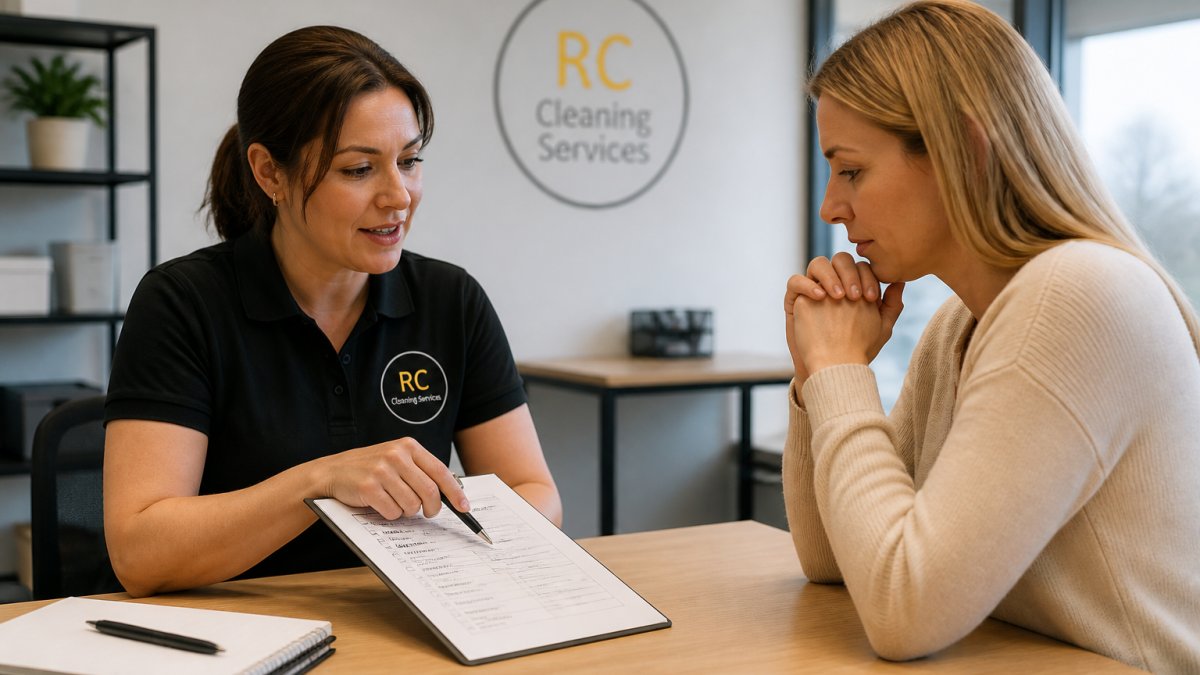
Cleaning budgets fail when they are built on guesswork instead of a documented scope. RC Cleaning Services, LLC builds every estimate through a personal consultation and walkthrough, so the number you receive reflects your actual facility rather than a generic rate. Our team delivers reliable, timely service with quality assurance checks that keep standards consistent visit after visit. Get started with RC Cleaning Services, LLC and lock in a cleaning contract that holds up all year.
BOOK ONLINE

Comments