
How to Handle Janitorial Service Complaints: 7 Steps

Table of Contents
Why Janitorial Complaints Happen and What They Cost You
Step 1: Document the Issue with a Cleaning Service Complaint Form
Step 2: Follow a Clear Cleaning Complaint Response Process
Define severity so triage is not a judgment call
Name an owner at every stage
Set a follow-up cadence
Step 3: Use a Janitorial Cleaning Checklist to Pinpoint Missed Tasks
Step 4: Learn How to Respond to a Customer Complaint About Cleaning
Step 5: Escalate to Management and Review the Service Agreement
Set escalation triggers in advance
Follow the escalation ladder with owners and response targets
Make the standard measurable
Renegotiate when the pattern persists
Step 6: Prevent Repeat Complaints with Root-Cause Analysis
Conclusion
Frequently Asked Questions
Last Updated: October 20, 2026
Why Janitorial Complaints Happen and What They Cost You
Most janitorial complaints come from a gap between what a client expects and what the crew was actually told to do. Learning how to handle janitorial service complaints starts with understanding where they come from.
The fix is rarely about working harder. It is about clearer scope, better records, and faster follow-up.
Complaints usually fall into a few buckets:
Inconsistent quality from visit to visit
Missed tasks like baseboards, vents, or restroom restock
Unreliable service with late or skipped visits
Communication breakdowns about schedule changes
Attention to detail gaps that show up during inspections
The cost is real. A failed walkthrough can delay a construction handover. A missed bathroom detail can cost a renter a security deposit.
The U.S. General Services Administration guidance on facility service contracts treats clear scope of work as the foundation of any custodial agreement.
Step 1: Document the Issue with a Cleaning Service Complaint Form
A cleaning service complaint form is a simple record that captures what went wrong, where, and when. It turns a vague "the bathrooms look bad" into something a provider can actually fix.

Build your form around these fields:
Date, time, and location of the issue
Specific task missed or standard not met
Photos or short video evidence
Who reported it and who was notified
Severity (routine, urgent, or safety-related)
Requested fix and deadline
A common mistake is reporting complaints by phone with no paper trail. In practice, that means no way to prove the issue was raised or resolved. Write it down every time.
Pro Tip Photograph the issue next to something that shows scale and location, like a door frame or a dated sticky note. It settles "was this really missed?" arguments in seconds.
Step 2: Follow a Clear Cleaning Complaint Response Process
A cleaning complaint response process is the sequence your team follows from the moment an issue is reported to the moment it is closed. Without one, complaints get handled differently by different people, nothing gets tracked, and the same issue resurfaces on the next walkthrough. The gap most providers leave open is not the list of steps, it is the absence of deadlines, named owners, and a written record at each stage.
Here is a workable process with response targets you can put in writing:
Log it in the complaint form the same business day, with date, time, location, task, and photo evidence.
Acknowledge the report to the client within one business day (same day for safety-related issues).
Triage by severity using the definitions below, and assign a priority level in the log.
Assign a fix to a named owner, not a crew, a person, with a correction deadline.
Correct the issue and confirm with the client, ideally with a follow-up photo from the same angle.
Close the ticket only after the client confirms, and record the closure date.
Review open and repeat tickets at the next scheduled check-in.
Define severity so triage is not a judgment call
Ambiguous severity is where response processes break down. Write the definitions into the agreement so both sides triage the same way:
Safety or health issue, bodily fluids, chemical spills, restroom sanitation failures, blocked exits, or anything that creates a slip, exposure, or contamination risk. Target acknowledgment within hours and correction the same business day.
Urgent operational issue, a missed restroom restock, overflowing trash in a client-facing area, or a missed visit that affects opening. Target acknowledgment within one business day and correction within 24 hours.
Routine quality issue, dusting, baseboards, glass smudges, or other cosmetic misses. Target acknowledgment within one business day and correction by the next scheduled visit.
Name an owner at every stage
A common failure pattern is a complaint that bounces between a crew lead, a dispatcher, and an account manager with no one accountable. Assign one owner per ticket and record the name in the log. On commercial sites, that owner is usually the account manager, with the crew lead responsible for the physical correction and the facility manager responsible for confirming closure.
Set a follow-up cadence
Acknowledgment and correction are only half the loop. Build in a follow-up: confirm the fix with the client within one business day of correction, and review the ticket at the next weekly or monthly check-in.
The acknowledgment step matters most. Clients forgive a missed spot. They do not forgive silence. A written response target, one business day for routine issues, same day for safety issues, gives the client something concrete to hold, and gives your team a deadline that is easy to meet.
Pro Tip Put the response targets and severity definitions in the service agreement, not just in an internal SOP. A target the client can see is a target your team will hit.
Step 3: Use a Janitorial Cleaning Checklist to Pinpoint Missed Tasks
A janitorial cleaning checklist lists every task expected per area, per visit. It gives both sides a shared standard, so "clean" stops being a matter of opinion.
Split your checklist by room and frequency:
Area | Daily Tasks | Weekly Tasks | Monthly Tasks |
Restrooms | Restock, sanitize, mop | Deep grout scrub | Vent dusting |
Conference rooms | Wipe tables, empty bins | Carpet spot clean | Baseboard wipe |
Lobby | Sweep, glass touch-up | Floor buff | Light fixture dusting |
Break room | Counters, appliances | Fridge interior | Cabinet fronts |
When a complaint comes in, check the list first. Was the task on it? If yes, it is a performance issue. If no, it is a scope issue. That single question saves hours of back-and-forth.
Watch Out Skipping a written checklist is the most common cause of repeat complaints. Crews guess, clients assume, and nobody can prove what was agreed.
Step 4: Learn How to Respond to a Customer Complaint About Cleaning
Knowing how to respond to a customer complaint about cleaning comes down to three moves: listen, own it, and set a fix date.
Try this response structure:
Acknowledge the concern without excuses
Ask for specifics if the report is vague
State what you will do and by when
Follow up after the fix to confirm it worked
Keep the tone calm and factual. "We hear you, and we will have someone re-clean that restroom by 4 p.m. today" beats a long explanation of why it happened.
For commercial clients with multiple stakeholders, send one clear update to the main contact. Copying five people creates noise, not clarity.
Step 5: Escalate to Management and Review the Service Agreement
Escalation is not a threat. It is a structured step for issues that keep coming back, and it works best when the triggers, owners, and deadlines are agreed before anyone is angry. Most complaint advice stops at "contact management." The useful version defines when to escalate, who owns each rung, how fast each rung must respond, and what measurable standard the service is being held to.
Set escalation triggers in advance
Write the triggers into the service agreement so escalation is a process, not a reaction:
Two documented complaints on the same task within 30 days, escalate to the account manager.
Any safety or health issue, escalate immediately, regardless of prior history.
A missed correction deadline, escalate one rung automatically.
Three or more complaints in a rolling 90-day period across different tasks, schedule a management review.
Follow the escalation ladder with owners and response targets
Crew lead, handles routine fixes. Acknowledges within one business day; corrects by the next scheduled visit.
Account manager, owns repeat issues and missed deadlines. Responds within one business day with a written correction plan and a date.
Management meeting, for unresolved or contract-level problems. Held within five business days of the escalation, with the complaint log and checklist in hand.
Contract review, if the pattern continues after a management meeting, review scope, standards, and termination terms line by line.
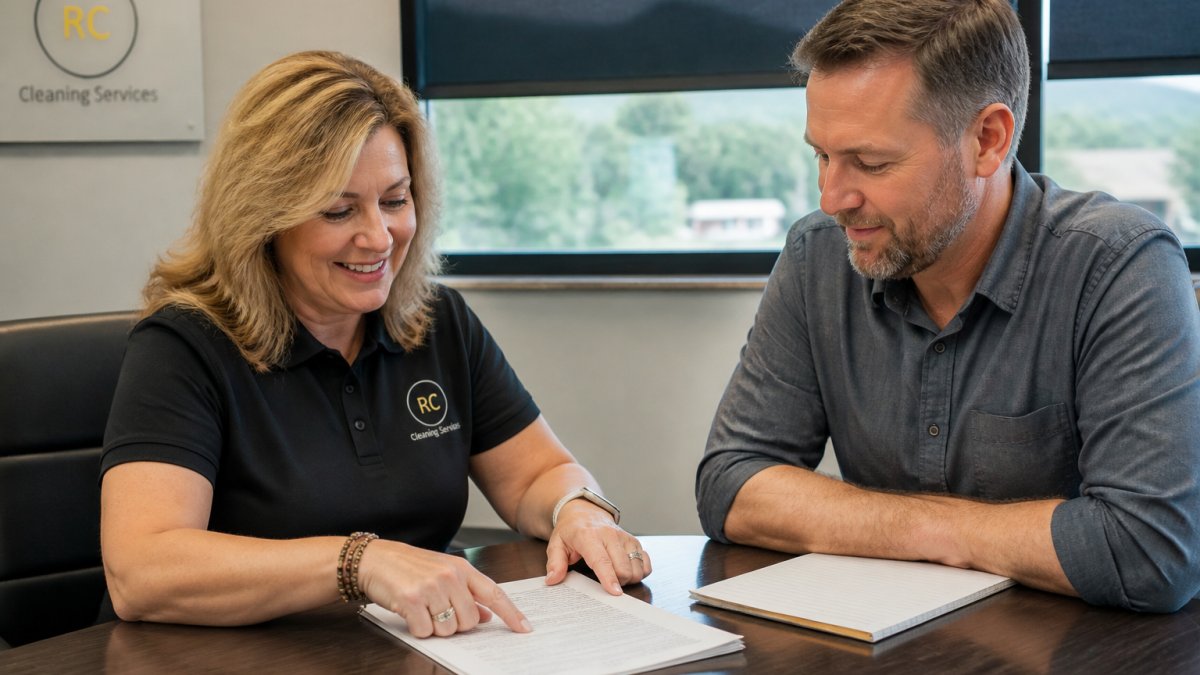
At the management meeting, bring your complaint log and your checklist. Then review the service agreement and scope of work line by line. Ask two questions: Is the task in scope? Is the standard measurable?
Make the standard measurable
"Clean" is not a standard; it is an opinion. A service-level agreement that holds up under a complaint defines measurable expectations, such as:
Inspection scores, a pass/fail or scored walkthrough on a defined checklist, with a target score and a re-inspection window.
Response times, acknowledgment and correction targets by severity, as described in the response process.
Repeat-defect rate, the share of tickets that recur on the same task within 30 days, tracked monthly.
Missed-visit rate, the share of scheduled visits completed, reported monthly.
If any of these is missing from the agreement, add it at the next review. A standard the provider cannot measure is a standard the client cannot enforce.
Renegotiate when the pattern persists
If the answer to either scope question is no, renegotiate the agreement. A clear scope of work protects both sides. The U.S. Small Business Administration's guide to contracts recommends putting performance standards and termination terms in writing from the start, and that advice applies directly to janitorial agreements: define the standard, the response target, and the exit terms before the first complaint, not after the third.
Key Takeaway Most "bad provider" situations are actually bad scope documents. Fix the paperwork, add triggers, owners, response targets, and measurable standards, and half the complaints disappear.
Watch Out Escalating without a written log usually stalls. Bring dates, photos, prior communications, and the specific contract clause to every management meeting.
Step 6: Prevent Repeat Complaints with Root-Cause Analysis
Repeat complaints are a signal, not a nuisance. When the same issue shows up three times, stop fixing symptoms and find the cause.
Run a simple root-cause check:
Was the task trained? If not, retrain the crew.
Was the task scheduled? If not, fix the visit plan.
Was the task checked? If not, add an inspection step.
Was the task realistic? If not, adjust the scope or frequency.
Track complaint frequency and repeat issues on a simple log. Review it monthly with your provider. Providers who welcome this tend to keep clients longer, because regular evaluations catch problems early.
Our quality assurance process relies on personal consultations and clear project estimates so expectations are set before the first visit.
Conclusion
Complaints will happen. What separates a good client-provider relationship from a bad one is how fast and how clearly the issue gets handled. Document it, acknowledge it, fix it, and review the pattern.
If you are tired of chasing missed spots and silent providers, RC Cleaning Services, LLC offers reliable janitorial services, quality assurance, and timely delivery backed by clear communication. We work with property managers, office teams, and construction project managers who need consistent results.
[BOOK ONLINE] with RC Cleaning Services, LLC and get a cleaning partner that answers when something goes wrong.
Frequently Asked Questions
What are the five steps of the complaint process for janitorial services?
The five steps are: document the issue with photos and a complaint form, submit the complaint to your provider, review the response and corrective action plan, escalate to management if unresolved, and follow up with an inspection to confirm the fix. Each step should have a timeline, such as a 24-hour acknowledgment and a 72-hour resolution window, so both parties know what to expect.
How should you respond to a complaint about a cleaning service?
Acknowledge the complaint within one business day, restate the issue to confirm understanding, and avoid blaming staff. Then investigate using your janitorial cleaning checklist and inspection records, propose a corrective action with a deadline, and schedule a follow-up inspection. Document everything in writing. A calm, factual response that focuses on the missed task rather than the person builds trust and reduces repeat complaints.
How do you document a cleaning complaint?
Use a cleaning service complaint form that records the date, time, location, specific missed task, and who discovered it. Attach photos or video, note any safety or sanitation risk, and list prior related complaints. Send the form by email so there is a timestamped record. For commercial facilities, copy the property manager or safety officer. This evidence supports escalation and contract review if the problem continues.
When should a business replace its janitorial service?
Consider replacement when the same complaint recurs three or more times, response times consistently exceed your service agreement terms, or inspection scores stay below target after a documented corrective action period. Before terminating, request a management meeting and a written improvement plan with measurable KPIs. If the provider misses that plan, review your contract's termination clause and transition to a new custodial provider with a clear scope of work.
BOOK ONLINE

Comments