
Commercial Construction Cleaning Services Cost Guide

Table of Contents
What Commercial Construction Cleaning Services Cost Includes
Rough Clean vs. Final Clean: What Each Phase Covers
Post Construction Cleaning Price Per Square Foot Explained
Pricing Models: Hourly, Flat Fee, and Per-Square-Foot Estimates
Factors That Influence Commercial Construction Cleaning Services Cost
Project Complexity, Site Accessibility, and Specialized Facilities
Post-Construction Cleaning Project Timeline: From Rough to Final
How to Remove Paint Spills from Commercial Flooring Safely
Contractor Liability, Insurance, and LEED Certification Standards
Insurance and Liability: What the Bid Should Prove
Safety Compliance on an Active Site
LEED and Green Cleaning Documentation
How Compliance Changes the Number
Hidden Costs, Surcharges, and Ongoing Maintenance Contracts
Frequently Asked Questions
Last Updated: September 16, 2026
What Commercial Construction Cleaning Services Cost Includes
Commercial construction cleaning services cost reflects the labor, equipment, and disposal work required to turn a raw job site into a move-in-ready space. At RC Cleaning Services, LLC, we build every estimate from the actual scope of work, not a generic formula. A crew arriving on day one of a rough clean faces a different job than one doing a final polish before an inspection. That difference drives the number more than square footage alone.
The price covers several distinct workstreams:
Debris removal and hauling of construction waste left behind by trades
Industrial vacuuming of fine drywall and concrete dust from every surface
Dust mitigation on vents, light fixtures, and horizontal ledges
Window detailing, including frames, tracks, and sticker removal
Floor care, from initial sweeping to stripping and waxing finished surfaces
HVAC vent cleaning so the building's air system isn't circulating grit
A common mistake is treating all of this as one line item. It isn't. Each phase has its own labor costs, cleaning supplies, and time requirements, and a good estimate separates them so you can see where the money goes.

Rough Clean vs. Final Clean: What Each Phase Covers
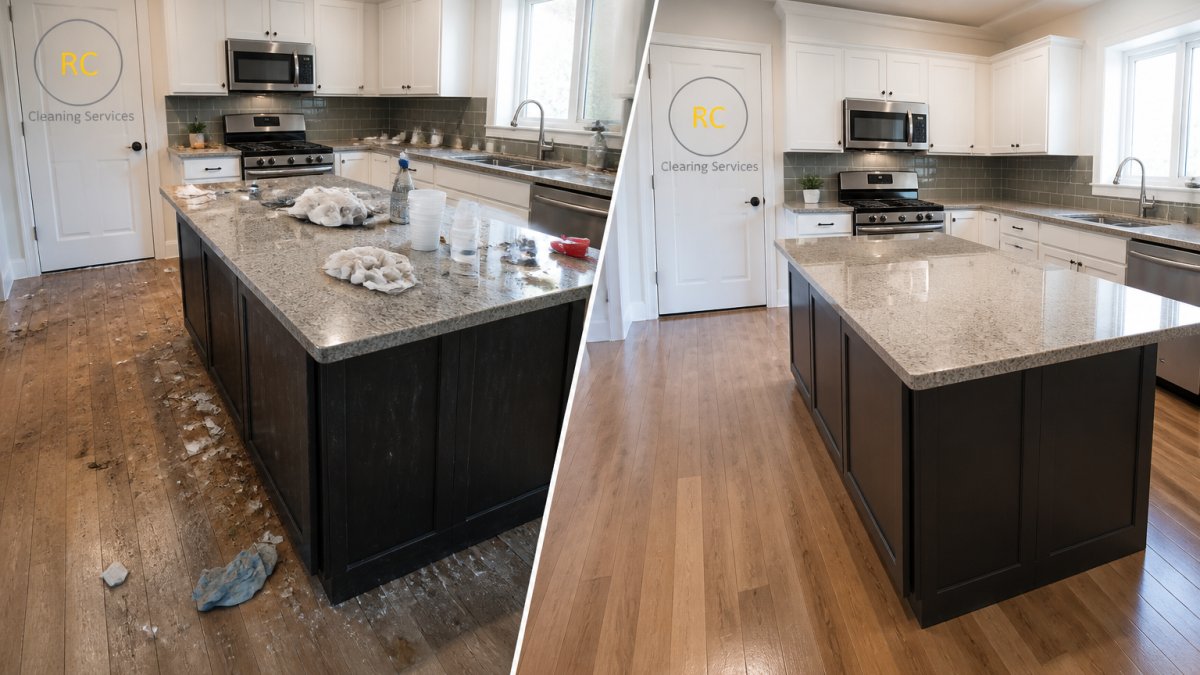
A rough clean is the first pass through a building after the major trades finish. Crews clear bulk debris, sweep floors, and remove the worst of the dust so other trades can keep working. It's fast, heavy work.
A final clean happens after all construction stops.
Post Construction Cleaning Price Per Square Foot Explained
Post construction cleaning price per square foot is the most common way commercial providers quote, because it scales predictably with building size. A per-square-foot estimate gives you a comparable figure across bids, but it only works when every bidder is pricing the same scope.
Pricing Models: Hourly, Flat Fee, and Per-Square-Foot Estimates
Three pricing models dominate commercial construction cleaning, and each fits a different kind of project.
Pricing Model | How It Works | Best For | Watch Out For |
Hourly rate | Billed per worker-hour | Small or uncertain scopes | Total cost is open-ended |
Flat fee | One fixed price for the scope | Well-defined, single-phase jobs | Change orders if scope shifts |
Per-square-foot estimate | Rate multiplied by building size | Large, predictable footprints | Only fair if scope matches |
Factors That Influence Commercial Construction Cleaning Services Cost
Project complexity moves the number more than raw size. Two buildings of identical square footage can land far apart on price once you account for what's inside them and how hard it is to reach.
The biggest drivers:
Project complexity: multiple floors, tight corridors, and heavy finishing trades all add labor hours
Site accessibility: limited parking, no freight elevator, or a single entry point slows every load of debris
Specialized facilities: medical-grade sanitization, labs, or food-service spaces require specific protocols
Ceiling height and fixtures: high bays and complex lighting take longer to detail
Debris volume: how much the trades left behind, and whether it's bagged or loose
Project Complexity, Site Accessibility, and Specialized Facilities
Site accessibility is the factor clients underestimate most. If a crew has to carry debris down three flights because the elevator isn't running yet, that's real time on the clock. A loading dock and working elevator can cut hours off a job.
Post-Construction Cleaning Project Timeline: From Rough to Final
A post-construction cleaning project timeline runs in three phases: rough clean, final clean, and touch-up. The full sequence usually takes days to a few weeks depending on building size, and it can't start until the trades are substantially finished.
Watch Out Starting the final clean before the trades are truly finished is the most common timeline killer. If a subcontractor returns to touch up paint after your final pass, you pay for the same surfaces twice.
How to Remove Paint Spills from Commercial Flooring Safely
Removing paint spills from commercial flooring safely starts with identifying the paint and the floor, because the wrong method damages the surface you're trying to save. Water-based paint lifts with warm water and a plastic scraper. Oil-based and epoxy paints need a solvent matched to the flooring.
The safe sequence:
Identify the paint type from the container or the trade that used it
Test in a hidden spot before touching the visible spill
Soften the spill with the right solvent or warm water, never a metal blade
Lift with a plastic scraper at a shallow angle
Wipe and neutralize so no residue remains to trap dirt
Match the finish so the cleaned patch blends with the rest of the floor
Pro Tip Keep a small labeled kit of the solvents you actually use and note which one works on which floor type. Crews that guess waste time and damage surfaces; crews that document finish faster and cleaner.
Contractor Liability, Insurance, and LEED Certification Standards
Liability, insurance, and certification requirements are where commercial construction cleaning bids quietly diverge, and where the cheapest number often stops being the cheapest job. Most cost guides skip this entirely. For a facility manager or general contractor, it is the part of the bid that determines whether the provider can legally and safely be on site at all.
Insurance and Liability: What the Bid Should Prove
A provider working on an active commercial site needs at least two coverages in place before mobilization:
General liability, covers third-party property damage and bodily injury. A crew that scratches a finished floor, breaks a fixture, or damages a trade's installed work is a liability claim, not a cleaning problem.
Workers' compensation, covers the cleaning crew if someone is injured on site. Without it, an injury can expose the property owner or general contractor to claims.
Safety Compliance on an Active Site
Construction site safety is the other half of the liability picture. Crews working around active trades need to follow the site-specific safety plan and the hazard controls required under OSHA construction industry standards for the conditions present, fall hazards, silica dust from concrete and drywall, electrical exposure, and struck-by risks from moving equipment. A provider that cannot show you its safety documentation and its crew's training records is a risk to your project schedule, not just your budget.
LEED and Green Cleaning Documentation
Sustainability requirements reshape the specification, not just the supplies. Projects pursuing certification under the U.S. Green Building Council's LEED program often need cleaning products and methods that support indoor environmental quality credits, low-VOC or certified green cleaning products, entryway and dust-control measures, and documented waste diversion for debris hauling.
Product selection shifts to certified green cleaning products, which can carry a higher unit cost than standard supplies.
Waste handling has to be documented, what was diverted from landfill, what was recycled, and where it went.
Paperwork becomes part of the deliverable. Credit submissions need records, and a provider that does not track disposal cannot supply them after the fact.
Watch Out A low bid that excludes insurance certificates, safety documentation, and green cleaning records is not a cheaper clean, it is a clean that can be stopped at the gate, fail a credit submission, or leave your project carrying the liability. Price the compliance, not just the labor.
How Compliance Changes the Number
Compliance requirements show up in the bid in three places: higher insurance and bonding costs carried by the provider, additional labor hours for documented procedures and safety compliance, and higher supply costs for certified products. A provider that prices all three up front gives you a number you can compare. A provider that leaves them out gives you a number that grows after mobilization, and by then, the schedule is already committed.
Hidden Costs, Surcharges, and Ongoing Maintenance Contracts
Hidden costs come from scope gaps, not from dishonest line items. The most common surcharges are debris hauling beyond the quoted volume, after-hours or weekend work to hit a deadline, and a return trip for a touch-up clean that wasn't in the original scope.
Key Takeaway The cheapest bid is rarely the cheapest job. A clear scope of work with defined inclusions protects your budget better than a low number with vague terms.
Frequently Asked Questions
How much should I charge for construction cleaning?
Pricing depends on square footage, project complexity, site accessibility, and which phase you are cleaning. Most contractors use either a per-square-foot estimate, an hourly rate, or a flat fee for the full scope. Rough cleans typically cost less per square foot than final or touch-up cleans because they involve less detail work. Get a site inspection and written scope of work before quoting so you account for debris removal, dust mitigation, and specialized tasks like HVAC vent cleaning or floor stripping and waxing.
What factors influence the cost of post-construction cleanup?
The biggest drivers are total square footage, number of stories, and site accessibility. Project complexity matters too: medical-grade sanitization, LEED certification requirements, and specialized facilities add labor and supplies. Other factors include the amount of debris removal needed, whether industrial vacuuming or window detailing is required, and how tight the post-construction cleaning project timeline is. Rush schedules and after-hours work often carry surcharges. A detailed site inspection is the only way to get an accurate estimate.
Is post-construction cleaning more expensive than standard janitorial services?
Yes, typically. Post-construction cleaning involves debris removal, heavy dust mitigation, industrial vacuuming, and detailed finish work that routine janitorial services do not cover. It also requires specialized equipment and often OSHA compliance training for construction site safety. Standard janitorial work is recurring and predictable, while construction cleaning is a one-time deep clean with variable scope. That said, many property managers bundle a final clean with an ongoing maintenance contract to reduce long-term costs.
How long does it take to clean a 10,000 square foot building?
A rough clean on 10,000 square feet might take one crew a full day, while a final clean with window detailing, floor stripping and waxing, and HVAC vent cleaning can take two to four days depending on crew size and site conditions. The post-construction cleaning project timeline also depends on how much debris removal and dust mitigation is needed. Schedule a site inspection early so the cleaning team can commit to a realistic completion date before your inspection deadline.
BOOK ONLINE
Comments